
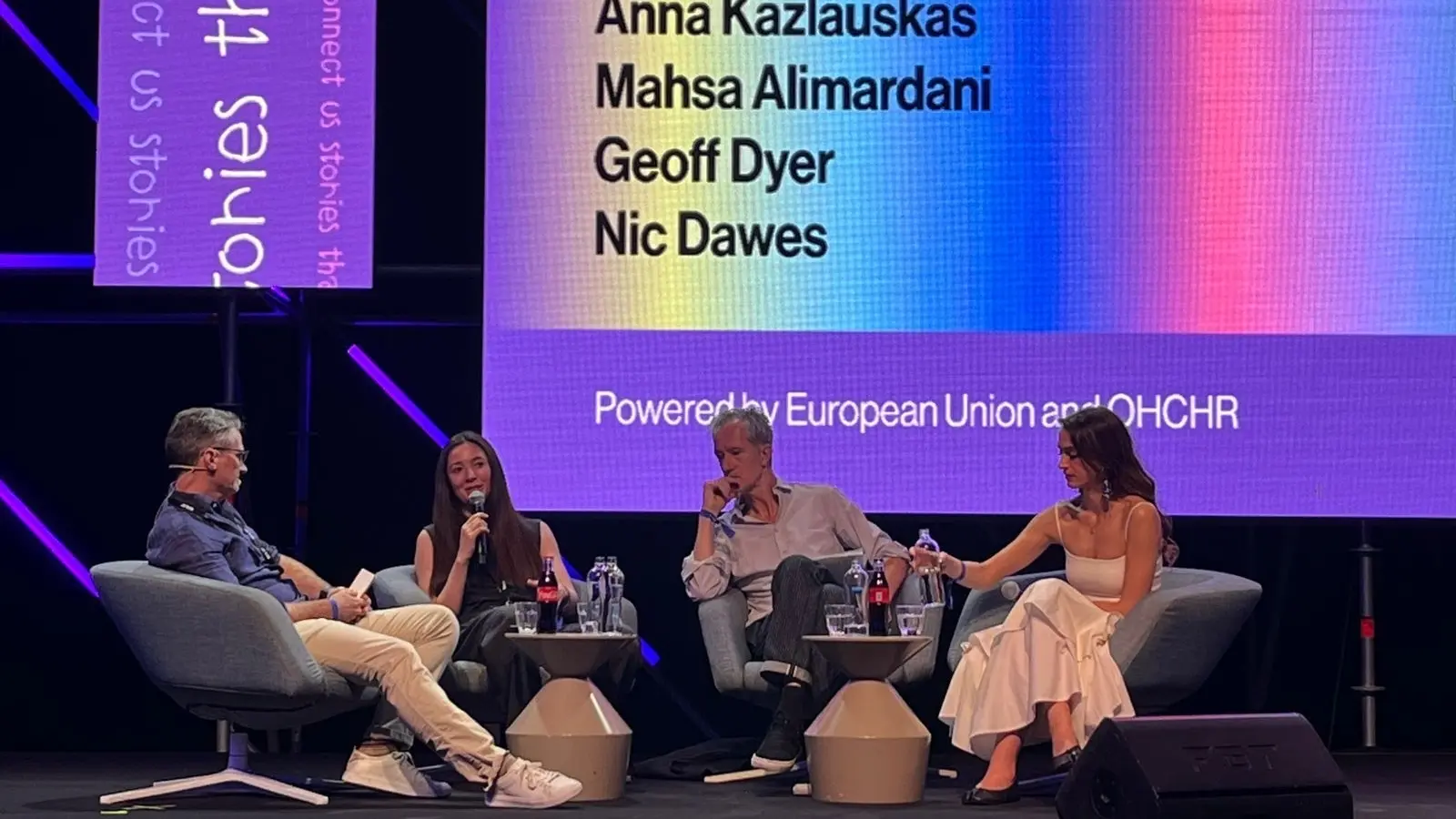
Last weekend, Vana CEO Anna Kazlauskas joined a panel at ZEG in Tbilisi, alongside human rights researcher Mahsa Alimardani and writer Geoff Dyer. The question they were asked to discuss: how is data a digital representation of the self?
ZEG is Coda Story's annual storytelling festival, running since 2019. The name comes from the Georgian word for "the day after tomorrow." It brings together journalists, writers, academics, and human rights workers in Tbilisi each June, deliberately held outside the usual conference circuit.
This year's edition drew over 1,000 participants and 140 speakers across three days. The lineup included Viet Thanh Nguyen, Pulitzer Prize-winning author of The Sympathizer; Karen Hao, journalist and author of Empire of AI; Zelda Perkins, whose decade-long campaign against abusive NDAs changed British law; and South African activist Kumi Naidoo, who has led both Greenpeace and Amnesty International.
The festival is shaped by Coda Story's editorial focus: authoritarianism on the rise, the abuse of technology, the manipulation of information. The 2026 edition was framed around a specific concern: AI accelerating all of those things at once.
-
The panel Anna joined brought together two voices from very different fields.
Mahsa Alimardani is a researcher at the Oxford Internet Institute studying how authoritarian governments control the internet, with a particular focus on Iran. She is also Associate Director at WITNESS, a human rights organisation, and a member of the Carnegie Endowment's Digital Democracy Network.
Her argument, developed in a March 2026 essay for Carnegie, is that digital repression has moved well beyond taking down posts or blocking websites. The real question is who owns the infrastructure: which voices get to travel across the network, and who gets cut off entirely.
Geoff Dyer is a writer and Royal Society of Literature fellow whose 2025 memoir Homework traces a working-class upbringing in post-war England. The book is really about how a self gets formed: what class, place, and era write into a person long before they have any say in it.
That question landed differently in a panel about data. If who we are is shaped by forces outside our control, then who holds the digital record of our lives matters enormously.
-
Elsewhere at the festival, Karen Hao was in conversation at a session called "The New Empire," discussing how a handful of companies have come to control the world's AI infrastructure by extracting vast amounts of data, energy, and labour from communities that see almost none of the return.
Anna carried one of Hao's points into the panel: that critiquing how AI is being built is not enough. The more urgent question is what a real alternative looks like.
Her argument was that personal data should be treated as a personal asset. That people should be able to decide what their data is used for, by whom, and on what terms. Data is not just a privacy issue. It is the raw material from which our digital lives are constructed, and whoever controls that material has enormous power over what AI systems know about us and how they treat us.
-
This is the problem Vana is built to address.
Vana is open data infrastructure for human-grounded AI. In plain terms: a protocol that lets people own and control their personal data, and choose what it serves, without having to go through a platform like Google or Meta to do it.
Right now, most personal data sits locked inside those platforms. People generate it constantly and control almost none of it. The AI systems being built on top of that data are trained on whatever the platforms decide to share, which is a partial and often distorted picture of who people actually are.
Vana changes how that works. Users own their context and decide how it flows. The 1.5 million people who have already connected their data to the network are not just early adopters. They are the foundation of a different kind of AI, one that starts from actual human context rather than scraped proxies for it.
Conversations like this one matter to Vana. Not as validation, but as orientation. The people in that room at ZEG are the ones shaping how society thinks about AI, and the questions they are asking are the right ones.
Vana's position is that there is a version of AI development that works for everyone: one where users have real control over their data, where researchers and developers can access genuine human context rather than scraped approximations of it, and where the value flows back to the people who created it. Building the infrastructure for that is the work.
Being in rooms like ZEG, alongside writers, human rights workers, and journalists who hold the hardest version of these questions, keeps that work honest. It is also how a protocol built on open rails becomes relevant beyond the communities that built it.
-
Vana is open data infrastructure for human-grounded AI. Learn more at vana.org.


