The Vana Cup: 43 Apps Built on the Context AI Is Missing
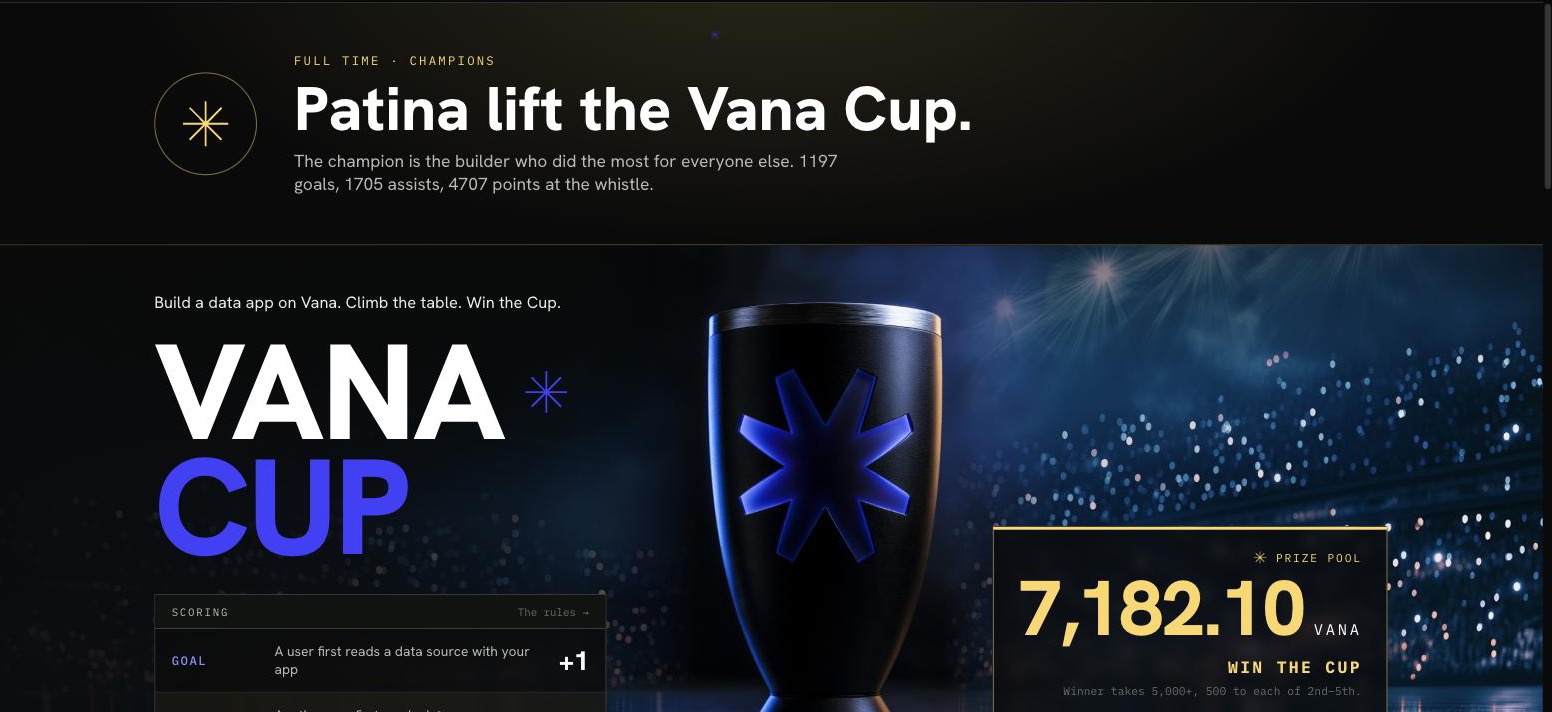
Forty-three apps went live on Vana during the Vana Cup, over three weeks from 25 July to 18 August 2026. More than 18,000 people connected their own data to one of them.
Each of those teams was competing to do the same thing in a different way: take data a person already owns, sitting in accounts they already have, and give them something back for it. A score, an answer, a rewrite, a valuation, a joke. The competition was a race to find out what that is actually good for.
The answer arrived faster than we expected. Daily activity on the network grew roughly eighty-fold across the window, from 34 recorded transactions on 1 August to 2,744 on 16 August. Apps kept entering right up to the final week. None of these builders had a partnership with Google, LinkedIn or Spotify. None of them scraped anything. In every case the user brought their own history across using Vana, at the record level, and could take it back whenever they wanted.
AI's missing input is context
Everyone agrees that models need context. Almost nobody can tell you where context is supposed to come from.
That question is about to get expensive. Gartner puts agentic AI in 33% of enterprise software applications by 2028, up from less than 1% in 2024, and in the same release expects more than 40% of agentic AI projects to be cancelled by the end of 2027 on escalating costs, unclear business value and inadequate risk controls. One survey of the agent tooling category attributes 65% of enterprise agent failures to context drift rather than to model capability.
Agents are being deployed everywhere, a large share will fail, and very few will fail because the model was not clever enough. They will fail because the system knew nothing real about the person it was working for, and an assistant that knows nothing real about you returns the average answer for everybody.
The blocker is not engineering. Context about a person is data about that person, and that data sits inside Google, inside LinkedIn, inside Spotify, inside a dozen platforms with no commercial reason to release it. The context problem presents as a retrieval problem and resolves into an access problem.
Vana is the infrastructure that unlocks it. It is data portability infrastructure: rails that let a person move the data a platform holds about them to somewhere they chose, and keep control of it at every step afterwards. Grant at the record level, revoke later, take your history with you, share in the value it creates. For a builder, the context arrives because the user sent it, with consent attached rather than assumed.
What one app can see when five platforms show up at once
Patina won the Cup, and it is the clearest demonstration of what portable data actually changes.
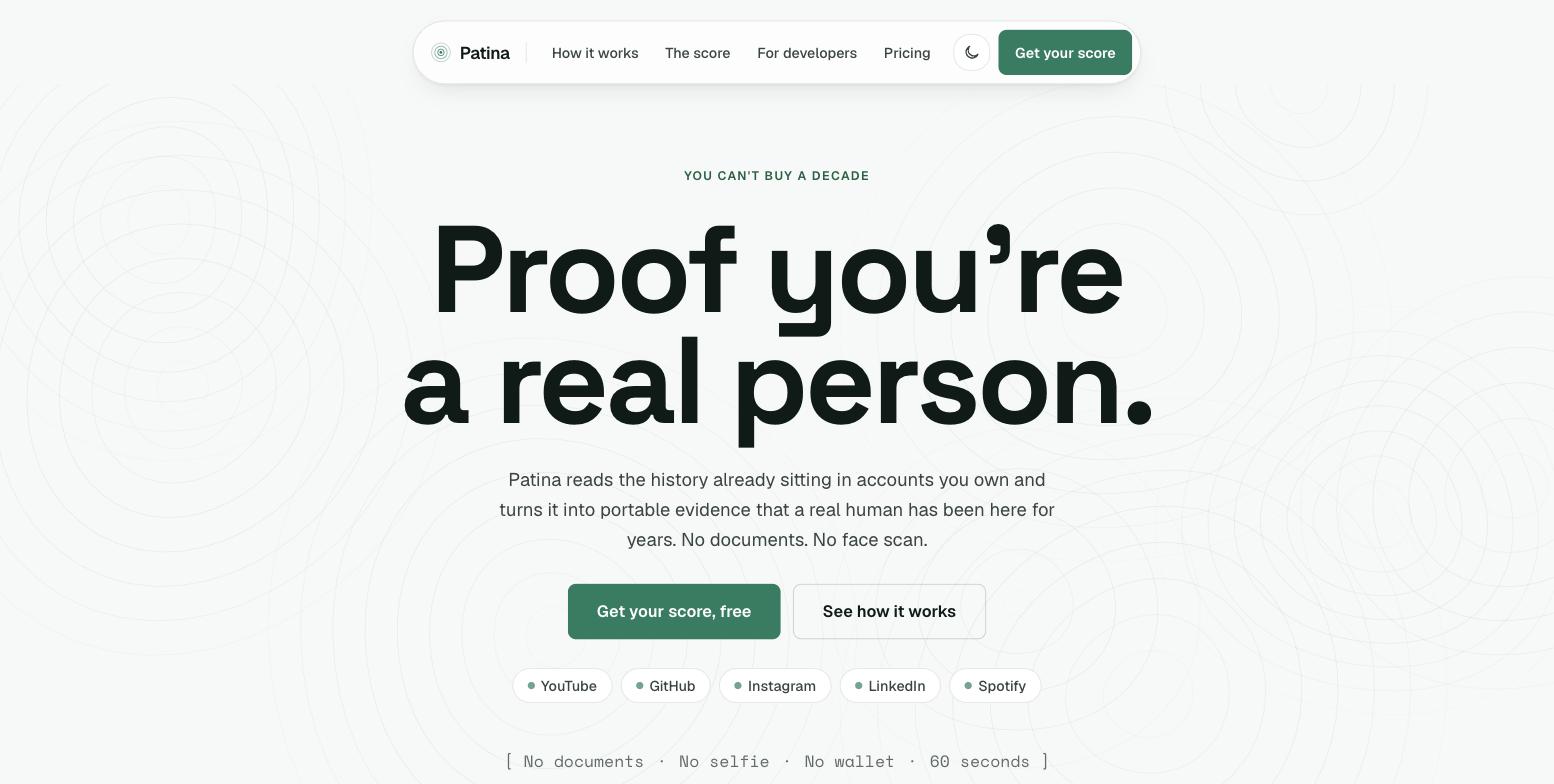
Patina answers a question every product now has to ask: is this a real person. More than half of internet traffic is automated, and the standard answers are to collect identity documents, collect a face scan, or pay a vendor who collects both on your behalf. Each one asks the user to give up more in order to prove they are real.
Patina asks for nothing new. It reads history already sitting in accounts the user owns, across YouTube, GitHub, Instagram, LinkedIn and Spotify, and turns it into a signed score.
The five is the point. Patina's model weighs account age, content depth, standing, breadth, and, crucially, corroboration across platforms. That last signal does not exist inside any single platform's API. Google can tell you about your Google account. Spotify can tell you about your Spotify account. Neither can tell you that the same person has been visibly, consistently present in five places for eight years, and neither has any commercial reason to help a third party find out.
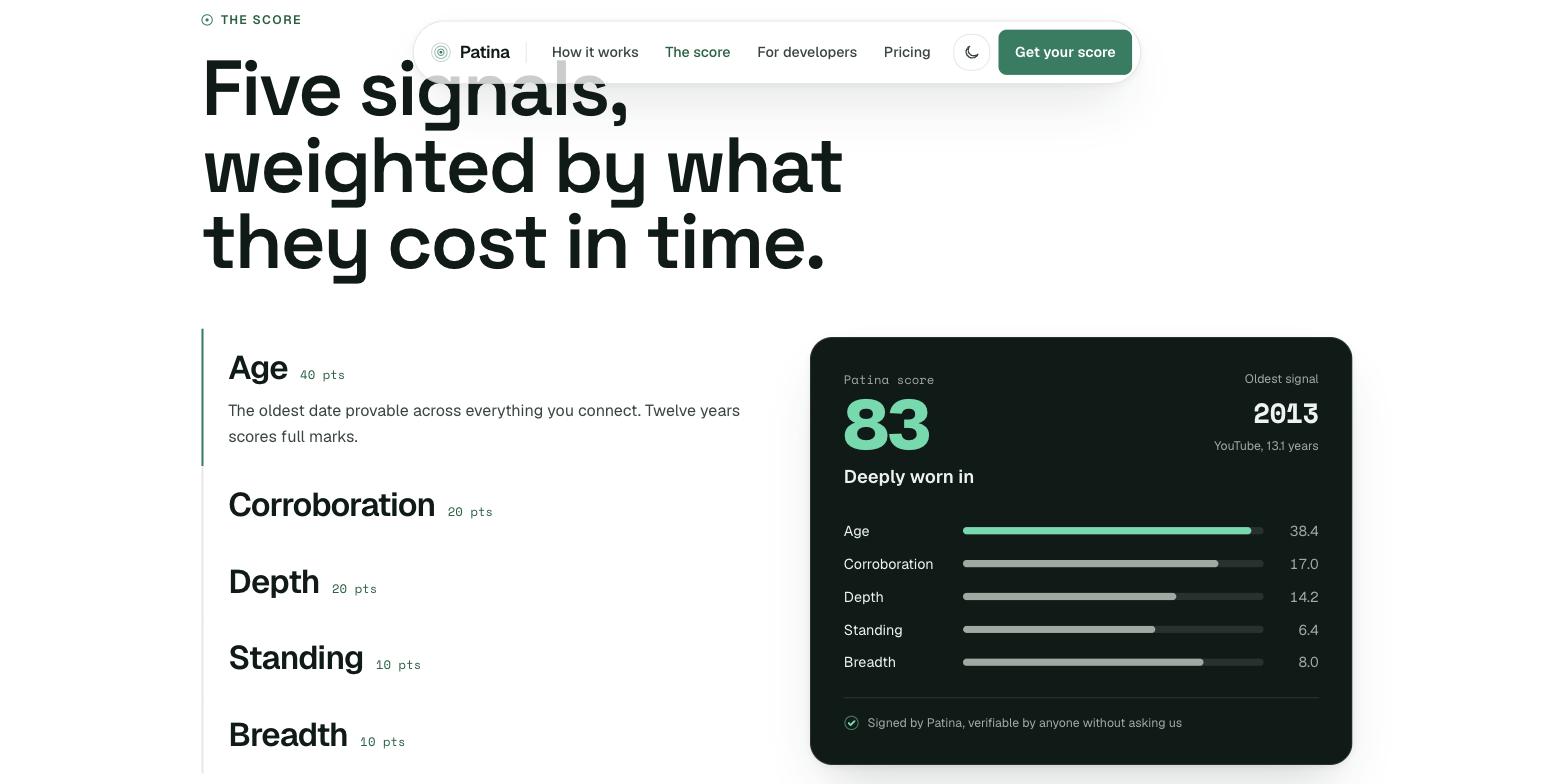
A user with Vana hands over all five at once, and the corroboration signal only exists because they did. That is what portable data does that no walled garden will ever sell: not access without a partnership, but access to a shape of evidence that forms only when sources are combined at the user's discretion, outside all of them.
The proof was always there. What was missing was any way for a person to gather it up and carry it somewhere it counted.
"We could not have built this on any single platform's API. The whole idea depends on being able to look across someone's accounts at once, and normally that means five separate partnership conversations we would never get. On Vana the user just brings it. That changes what is possible to build, and it means we are not waiting on anybody's permission to serve our own users."
Ram, Patina
What else portable context unlocked
The rest of the field found other things the same rails make possible.
Price tag reads your real work history and returns an honest salary range and freelance rate, with its reasoning shown and specific suggestions for what would move the number. Reprofile audits your professional profile and rewrites it. Career Coach and Path Fit work on direction rather than price. All of these have been attempted many times on self-reported data and never worked properly, because self-reported data is aspirational and incomplete. Given the real history, they get useful.
Mirror, Playlist Shelf, Personal Museum and Nime-tube work on taste, built from listening and viewing histories. BIOME and Devfit work on health. Data-Passport and Context Passport carry identity between places. Ministry of Gay issues a satirical licence generated from Instagram history and pulled in more data than any other app in the competition. Roastify, RoastX, 67 Card and Cek Khodam are, broadly, jokes.
Nobody was told what category to build in. Trust infrastructure at one end and meme generators at the other is what core data infrastructure for AI looks like in its first month, and the jokes count as evidence too, because infrastructure that only serves serious applications is a vertical.
The business case
Two things happened in the Cup that do not happen in a walled garden, and together they are why Vana exists.
The first is the one above. A user can combine sources no platform will combine for you, and the combined view is more valuable than any single feed. Every product in the field was built on a shape of data that would otherwise have required multiple partnership deals, most of which would never have been granted to a three-week-old app.
The second is that the context kept moving. Data that entered the network through Patina was read by a different app 1,699 times. Patina did not build a career tool or a commerce product or a social product. It made its context readable, and the apps that needed to know whether they were dealing with a real person read it.
Under every other approach available today that number is zero. Scraped data does not travel. Integrated data belongs to the integration. Data a user pastes in dies in the app they pasted it into. Brokered data arrives with no permission attached. Only portable context can be brought in by one app and used by another with the person in control the whole way. That is the difference between a database and infrastructure.
That is also where the compounding sits. Every app that brings context in raises what the next one can read, and the value of a record rises with the number of applications able to act on it. The competition ran for three weeks and one app already earned more from other people's products than from its own. A network with that property gets more useful per participant as it grows, which is the property worth underwriting.
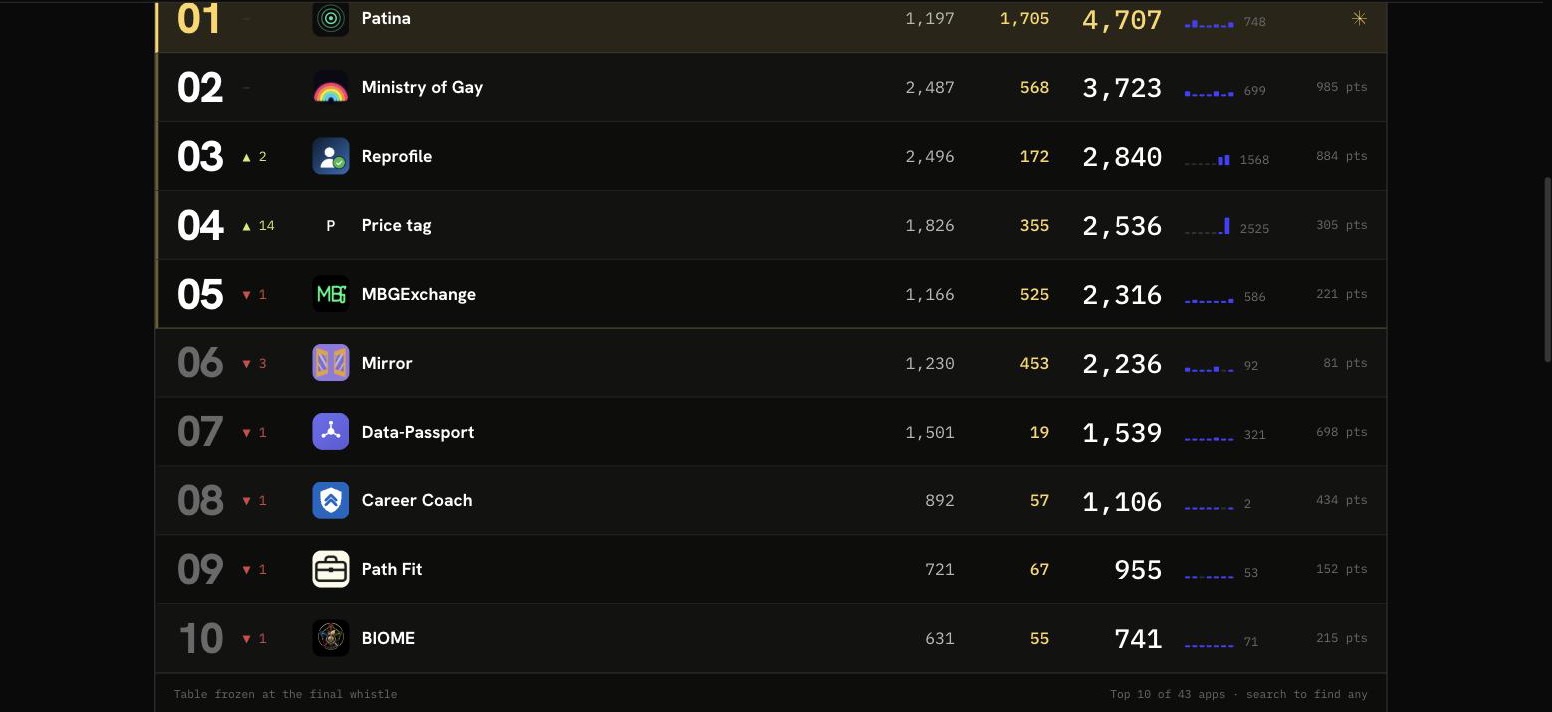
| # | App | Points | Data brought in | Read by other apps |
|---|---|---|---|---|
| 1 | Patina | 4,693 | 1,195 | 1,699 |
| 2 | Ministry of Gay | 3,723 | 2,487 | 568 |
| 3 | Reprofile | 2,840 | 2,496 | 172 |
| 4 | Price tag | 2,536 | 1,826 | 355 |
| 5 | MBGExchange | 2,316 | 1,166 | 525 |
| 6 | Mirror | 2,236 | 1,230 | 453 |
| 7 | Data-Passport | 1,539 | 1,501 | 19 |
| 8 | Career Coach | 1,106 | 892 | 57 |
| 9 | Path Fit | 955 | 721 | 67 |
| 10 | BIOME | 741 | 631 | 55 |
Patina is the only app in the top ten that was read more than it collected, and one of only two across all 43. Everyone else's context was worth more to itself than to anybody else, which is what a first month looks like before the reading side catches up.
This is just the start
Congratulations to Patina, to the top five, and to every team that shipped something during the Cup. Forty-three apps in three weeks, built largely by people who had not worked with portable data before, is a stronger first showing than we planned for.
We want to support the next group properly. If you are building something that needs to know something real about the person using it, the rails are live on mainnet and documented at docs.vana.org, and we want to hear from you.
Compute is solved. Inference is solved. The agent harnesses arrived this year. Context is the piece still missing. Real context from real humans is what makes AI work, and forty-three teams just spent three weeks showing what happens when people can bring it themselves.
Notes on the numbers: agentic AI adoption and cancellation forecasts from Gartner; the context drift figure via Value Add VC. Cup rank 1 is the referee-confirmed frozen result; ranks 2 to 10 were read from the network indexer shortly after the freeze while it was still settling late transactions. Points were awarded as one per record brought in and two per record read by another app.